 | USA
| USA | México
 | India
 | Canada
 | Colombia
 | Brazil

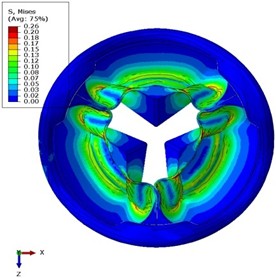
The cardiovascular medicine is advancing tremendously thanks to the continuous upgradation of innovative medical devices. The employment of Finite Element Modelling (FEM) has helped a lot to ensure the proper virtual lab conditions to enhance the performance of various cardiovascular devices like the pacemaker or the stent.
The human cardiovascular system is an intricate network, and the methods & devices we employ to treat the system face unique challenges. For example, a stent in a blood vessel withstands high stress due to fluctuating blood flow, and the cyclic load variations can cause fatigue in the material. Assisted by the FEA, engineers and medical researchers can model these devices & analyze their performance to optimize their designs. More than 200,000 heart valve replacement surgeries are performed yearly worldwide, predicting an increase to 850,000 by 2050.
Applications of FEA in Cardiovascular Device Analysis
Stent Design and Optimization
One of the FEA applications is the design and analysis of stents. A stent is a small device used to prop open a blood vessel and improve blood flow. With finite element modelling, engineers can simulate the behaviour of different stent designs under various scenarios and find the best design.


Crack Growth Simulation in Bones
FEA can characterize soft tissue materials and bone structures. FEA delves into the simulation of crack growth in bones under a three-point bending test. This is highly important for understanding bone fractures, their failure mechanisms, and helping researchers develop better implants and treatments.
Fluid-Structure Interaction (FSI) Simulations
The Fluid-Structure Interaction (FSI) simulation capability offers a key perspective on hemodynamics. By simulating blood flow through blood vessel mechanics, researchers can study the impact of hemodynamic factors like pressure, flow rate, and shear stress on vascular diseases such as atherosclerosis and aneurysms. This helps in the development of more effective treatments and preventive measures.
Conclusion
In conclusion, the Finite Element Method is playing a key role in the biomechanical analysis of cardiovascular devices. From stent design to bone fracture simulations and FSI studies, this software is an indispensable tool for researchers and engineers. By using FEA, we can enhance the safety and efficiency of cardiovascular devices, bringing us one step closer to life-changing treatments and interventions.
As FEA continues to evolve and advance, we can expect even more remarkable innovations in the realm of cardiovascular medicine, shaping a healthier future for us all.
About VIAS3D
VIAS3D engineering and simulation team combines decades of analytical and design experience. We have successfully helped to design various products from many industries for strength, stability, rigidity, and fatigue endurance. Our design and analysis capabilities are accomplished through advanced engineering modeling techniques such as Finite Element Analysis (FEA) using Abaqus, Computational Fluid Dynamics (CFD), and other tools.
Using these advanced tools, we can capture complex design features and nonlinearities arising from materials, geometry, and surface interactions to simulate designs and predict their response before they are brought into production.
Please email us at achakraborty@viascorp.com or drop a message at: https://www.linkedin.com/in/arinc16/
Contributors:
Agniva Hazra, B.E Civil Engineering (2025), is an intern at VIAS3D. He is a final year undergrad pursuing his bachelor’s from Jadavpur University (INDIA).
References
- National Library of Medicine, journal on Finite Element Analysis of a Novel Aortic Valve Stent
- JTCVS open, journal on Biomechanical analysis of novel leaflet geometries for bioprosthetic valves