 | USA
 | México
 | India
 | Canada
 | Colombia
 | Brazil


Aeroelastic behavior plays a critical role in the safety and structural performance of aircraft components. For wings and other flexible aerodynamic structures, the interaction between airflow and structural deformation can significantly influence vibration characteristics and overall stability. Understanding this interdependent behavior is essential to identifying critical operating conditions and preventing aeroelastic instabilities such as flutter.
Flutter is a dynamic instability that occurs when aerodynamic forces interact with structural elasticity and inertia, causing oscillations that can grow rapidly beyond a critical condition. Capturing this behavior requires both the aerodynamic loads acting on the structure and the resulting structural deformation to be evaluated together. Co-simulation provides an effective approach by enabling fluid and structural solvers and exchanging data at frequent steps, allowing the full fluid–structure interaction across the interface to be represented.
At VIAS3D, we leverage advanced Multiphysics simulation techniques to analyze complex aeroelastic and fluid–structure interaction problems. By coupling Simcenter STAR-CCM+ for Computational Fluid Dynamics with Abaqus for structural analysis, aerodynamic loads and structural deformation can be exchanged continuously between the two solvers. This enables engineers to evaluate the transient response of flexible structures under realistic aerodynamic loading conditions.
VIAS3D performed an Aeroelastic Flutter Analysis on a Wing using Simcenter STAR-CCM+ and Abaqus Co-Simulation. The analysis began by preparing the aerodynamic model in Simcenter STAR-CCM+ and the corresponding structural model in Abaqus, followed by configuring the models for co-simulation and establishing the external coupling between the two solvers. During the simulation, STAR-CCM+ transferred aerodynamic traction loads—including pressure and wall shear stress—to the wing surface in Abaqus. Abaqus then calculated the structural response and transferred the resulting displacements back to STAR-CCM+, where the mesh morpher updated the CFD domain to account for the wing deformation.
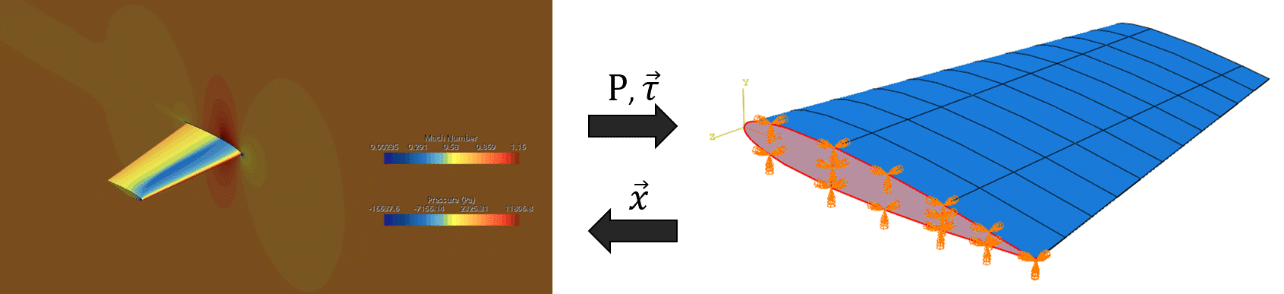
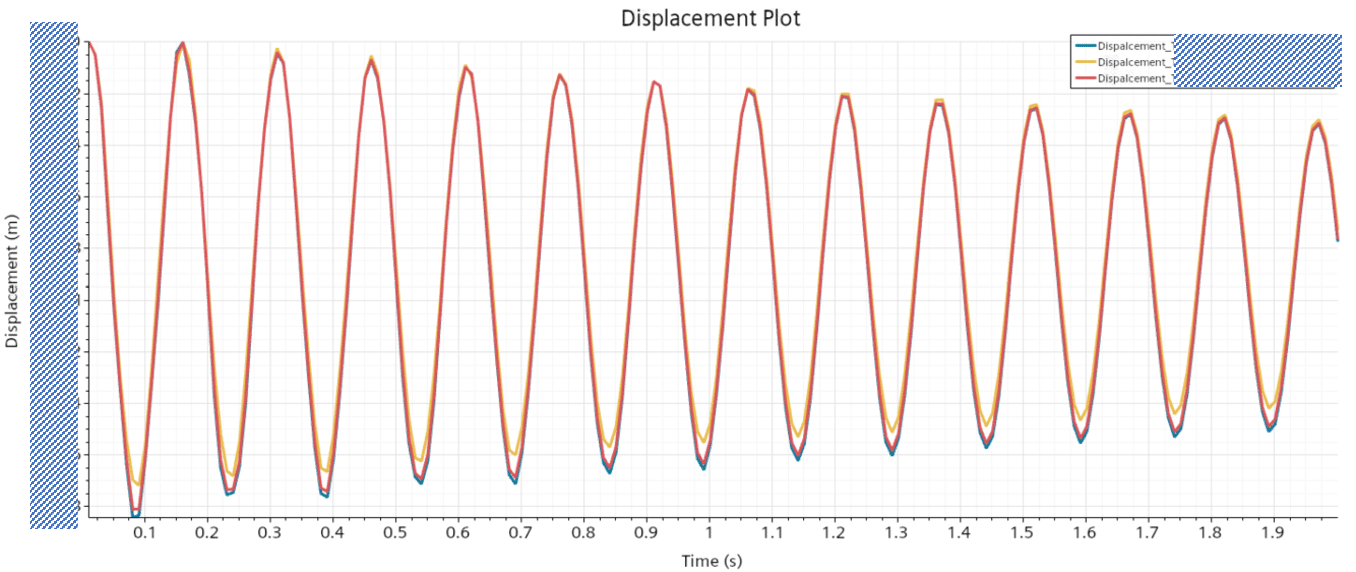
Through this iterative simulation approach, the transient interaction between aerodynamic loading and structural response was captured throughout the analysis. The resulting wing deformation and oscillatory behavior provided insight into the aeroelastic response of the structure and supported the assessment of potential flutter behavior. This type of co-simulation enables engineers to study complex fluid–structure interactions virtually, improve understanding of critical operating conditions, and support safer and more reliable aerodynamic designs.
Flutter is one of several cases where the fluid and the structure have to be solved together rather than in sequence. The same coupled approach applies to flow-induced vibration, dynamic fluid-body interaction, and conjugate heat transfer. Accuracy in each case depends on both halves of the model: our CFD consulting services cover the aerodynamic side, including turbulent and transient flow, aeroacoustics, and multiphase modeling, and our FEA consulting services cover the structural side, including nonlinear and dynamic response, frequency and vibration, buckling, and fatigue.
If you would like to know more about VIAS3D capabilities about Fluid Structure Interaction, Aeroelasticity, Flutter Analysis, Instability Analysis, please email us at achakraborty@vias3D.com, mlakshmiraju@vias3D.com, info@vias3d.com or drop a message on LinkedIn to Arindam Chakraborty or Murthy Lakshmiraju.
About VIAS3D
VIAS3D engineering and simulation team combines decades of analytical and design experience. They have successfully helped to design various products from many industries for strength, stability, rigidity, and fatigue endurance. Our design and analysis capabilities are accomplished through advanced engineering modelling techniques such as Finite Element Analysis (FEA), Computational Fluid Dynamics (CFD), Electromagnetics (EMAG) and other tools. Using these advanced tools, we can capture complex design features and nonlinearities arising from materials, geometry, and surface interactions to simulate designs and predict their response before they are brought in production.
Contributors:
Murthy Lakshmiraju, Ph.D., Engineering Consulting Director at Vias3D
Dr. Lakshmiraju has over 15 years of advanced use and experience in CFD to solve real-life engineering problems for numerous industries, including appliances, energy, oil and gas, and marine, and chemical processing. He graduated with a Master and PhD in Mechanical Engineering from Tennessee Tech, USA. He has experience in different flow physics, including advanced turbulence modeling, multiphase flow, heat transfer, Dynamic Fluid Body Interaction (DFBI), Fluid-Structure Interaction (FSI), Chimera mesh, Conjugate Heat Transfer (CHT), and reacting flows with combustion and emission modeling.
Akshay Dandekar, PhD, PE (OH), Senior Engineer
Dr. Dandekar is a mechanical engineer with more than 5 years of academic and consulting experience in solid mechanics, fracture mechanics, material characterization and finite element analysis. He holds a PhD in mechanical engineering from Purdue University and master’s in aerospace engineering from the University of Illinois. He is a registered professional engineer in Ohio.
Sai Sandeep Pydisetti, Sr. CFD Engineer at VIAS3D
Mr. Pydisetti has industrial experience in CFD modeling and simulations, consulting, and technical support. He has worked on a wide range of applications, including aerodynamics, acoustics, thermal, multiphase, and reacting flow applications. His professional interests involve CFD simulation and analysis of fluid dynamics and heat transfer applications.