 | USA
| USA | México
 | India
 | Canada
 | Colombia
 | Brazil

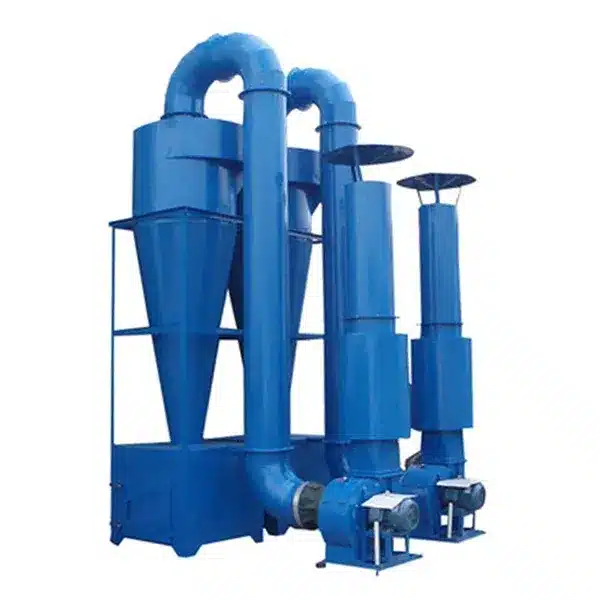
Cyclone separators are widely used across engineering applications to remove solid particles from a fluid stream or to separate immiscible fluid phases using centrifugal forces. Common applications include removing sand and debris from oil-well production fluids, recovering catalyst particles from reactor effluent, and separating contaminants prior to disposal or downstream processing.
Simulation tools play a valuable role in separator design by providing detailed insight into the internal flow field and particle behaviour. CFD visualization, including velocity vectors, pressure distributions, and particle trajectories, helps identify which geometric features promote effective separation and which may require refinement to improve efficiency.
VIAS3D conducted a CFD study to evaluate the performance of a different cyclone separators in separating sand particles from a multiphase mixture of water, oil, and gas representative of oil-well production fluids. The analysis was carried out to understand the internal flow behaviour and assess the separator’s efficiency under realistic operating conditions.
The CFD simulations provided detailed insight into the swirling flow structure, pressure distribution, and sand-particle motion inside the separator. Using multiphase flow and particle-tracking methods, the study captured how sand particles interacted with the rotating flow field, allowing evaluation of particle residence time, separation behavior, and overall separation efficiency. The results also helped identify regions of particle recirculation and potential carryover that could affect separator performance.
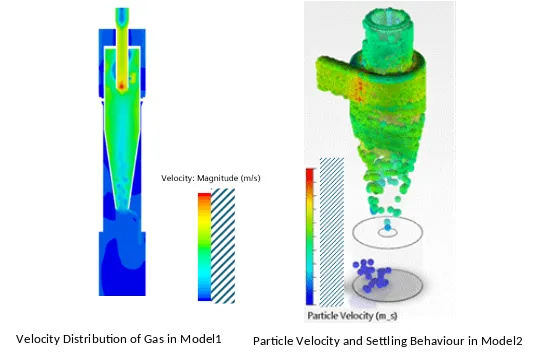
Insights from the CFD analysis were used to optimize the cyclone separator design and improve sand separation effectiveness. By evaluating separator performance virtually before fabrication, CFD provided a cost-effective approach for refining the design and improving operational reliability.
About VIAS3D
VIAS3D engineering and simulation team combines decades of analytical and design experience. They have successfully helped to design various products from many industries for strength, stability, rigidity, and fatigue endurance. Our design and analysis capabilities are accomplished through advanced engineering modelling techniques such as Finite Element Analysis (FEA), Computational Fluid Dynamics (CFD), Electromagnetics (EMAG) and other tools. Using these advanced tools, we can capture complex design features and nonlinearities arising from materials, geometry, and surface interactions to simulate designs and predict their response before they are brought in production.
For more details about our software solutions, training, engineering / PLM services or consulting needs, please email us at achakraborty@vias3D.com, mlakshmiraju@vias3D.com, info@vias3d.com or drop a message on LinkedIn to https://www.linkedin.com/in/arinc16/, https://www.linkedin.com/in/murthylakshmiraju/
Contributors:
Devanik Ghosh, Intern at VIAS3D,is a chemical engineering graduate.
Sai Sandeep Pydisetti, Sr. CFD Engineer at VIAS3D
Mr. Pydisetti has industrial experience in CFD modeling and simulations, consulting, and technical support. He has worked on a wide range of applications, including aerodynamics, acoustics, thermal, multiphase, and reacting flow applications. His professional interests involve CFD simulation and analysis of fluid dynamics and heat transfer applications.
Murthy Lakshmiraju, Engineering Consulting Director
Dr. Lakshmiraju has over 15 years of advanced use and experience in CFD to solve real-life engineering problems for numerous industries, including appliances, energy, oil and gas, and marine, and chemical processing. He graduated with a Master and PhD in Mechanical Engineering from Tennessee Tech, USA. He has experience in different flow physics, including advanced turbulence modeling, multiphase flow, heat transfer, Dynamic Fluid Body Interaction (DFBI), Fluid-Structure Interaction (FSI), Chimera mesh, Conjugate Heat Transfer (CHT), and reacting flows with combustion and emission modeling.